ISO certified unit in India that manufactures of Strainer

ISO certified unit in India that manufactures of Strainer
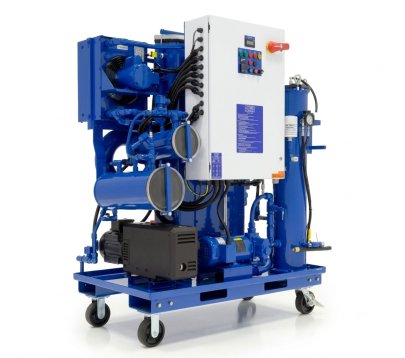
Vacuum Dehydration Systems restore transformer and turbine oil to sub-10 ppm moisture content and dielectric breakdown voltages exceeding 60 kV — the performance benchmark specified in IEC 60422 and IEEE C57.106 for in-service transformer oil maintenance.
Engineering & Working Principle
Oil is gently pre-heated to 45–65°C and sprayed as a thin film into a vacuum chamber held at 1–5 mbar absolute pressure, dramatically lowering water's effective boiling point so dissolved and emulsified moisture flashes into vapor and is extracted by a vacuum pump. Dissolved gases are simultaneously stripped, while inline particulate filtration polishes the treated oil before it re-enters service.
Technical Specifications
Standards Compliance
IEC 60422 (in-service transformer oil maintenance), IEEE C57.106, IEC 60156 (dielectric breakdown test method)
Key Features
Applications
Power and distribution transformers, generator step-up transformers, turbine lube/hydraulic oil, and switchgear insulating oil.
Why It Outperforms Standard Systems
Basic dehydration units rely on heat alone, risking oil oxidation. Our systems balance vacuum depth and controlled low-temperature heating to achieve IEC 60422-grade moisture and dielectric results without degrading the oil's oxidation stability — the same balance specified by transformer OEMs.
Benefits
Our systems typically achieve below 10 ppm moisture content from influent levels above 50 ppm, restoring dielectric breakdown voltage to above 60 kV per IEC 60156 test method.
Heat alone risks oxidizing the oil; combining a controlled vacuum (1–5 mbar) with moderate pre-heating (45–65°C) lowers water's effective boiling point enough to flash off moisture without degrading the oil's oxidation stability.
Yes — the vacuum stage simultaneously strips dissolved gases at over 90% efficiency, which is critical for transformer oil health monitoring and dissolved gas analysis (DGA) baseline resets.
Before and after treatment, oil is tested for moisture content (Karl Fischer method) and dielectric breakdown voltage per IEC 60156, with full documentation provided per IEC 60422 guidance for in'service transformer oil.
Yes — trailer-mounted and skid-mounted mobile units are available for on'site treatment of power transformers, distribution transformers, and switchgear insulating oil without requiring the asset to leave service longer than necessary.