ISO certified unit in India that manufactures of Strainer

ISO certified unit in India that manufactures of Strainer
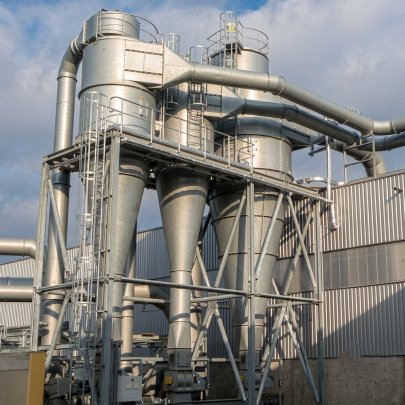
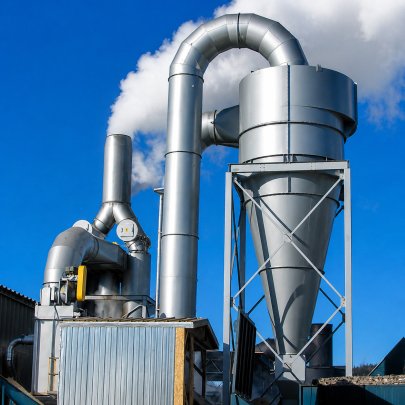
High-efficiency Cyclone Separators are engineered using computational fluid dynamics (CFD)-optimized geometry to deliver collection efficiencies rivaling far more expensive filtration systems — with zero moving parts and near-zero maintenance. Our designs follow classical Lapple and Stairmand high-efficiency cyclone geometries, refined through CFD modeling for site-specific particle size distribution.
Engineering & Working Principle
Dust-laden gas enters tangentially at 15–25 m/s inlet velocity, generating a vortex that can exceed 5,000 RPM equivalent centrifugal acceleration near the cyclone wall. Particles above the cut-diameter (typically 5–15 microns for high-efficiency designs) are flung to the wall and spiral down into the hopper, while the cleaned gas reverses direction and exits through the vortex finder.
Technical Specifications
Standards Compliance
Designed to support compliance with US EPA NSPS, EU IED, and CPCB particulate emission limits when used as pre-cleaner or standalone unit within permitted limits
Key Features
Applications
Woodworking and biomass plants, cement and mineral processing, foundry sand reclamation, boiler pre-cleaning, and pneumatic conveying systems.
Why It Outperforms Standard Designs
Generic cyclone designs are sized from rule-of-thumb charts. Ours are CFD-modeled against your actual particle size distribution and gas flow, delivering measurably higher cut efficiency and lower pressure drop than off-the-shelf units — critical when cyclones feed a downstream baghouse or ESP.
Benefits
High-efficiency CFD-optimized designs achieve 85–95% collection for particles above 10 microns, and up to 99% when arranged in multi-cyclone banks — well beyond generic rule-of-thumb cyclone designs.
For coarser dust loads, yes, within permitted limits; for fine particulate (PM2.5) compliance under stricter EPA/EU IED limits, cyclones are typically used as a pre-cleaner stage ahead of a baghouse or ESP.
Standard units operate up to 400°C in mild steel or stainless construction; refractory-lined variants handle 800°C+ for applications like kiln off-gas or high-temperature process exhaust.
Very little — with zero moving parts, maintenance is limited to periodic hopper dust removal and inspection of the abrasion-resistant liner in high dust-load applications.
Cut-diameter (d50) determines the particle size at which 50% collection efficiency is achieved — a properly CFD-modeled cyclone against your actual particle size distribution ensures the unit is correctly sized, rather than under- or over'specified.