ISO certified unit in India that manufactures of Strainer

ISO certified unit in India that manufactures of Strainer
Our Electrostatic Precipitators are engineered using the same design principles deployed in the world's largest thermal power stations — achieving 99%+ particulate collection efficiency, including sub-micron PM2.5 fractions, at a fraction of the pressure drop of fabric filters. Design follows ICAC EP-7 and IEEE 548 guidelines for electrical sizing and mechanical rapping systems.
Engineering & Working Principle
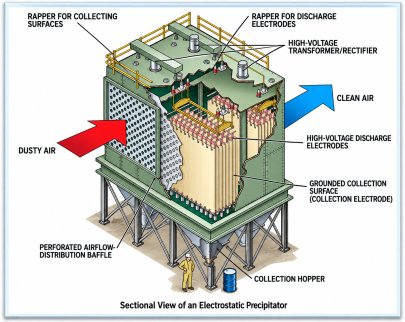
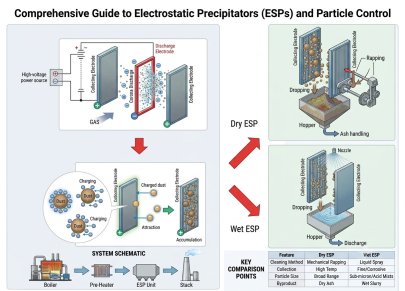
Dust-laden gas passes through discharge electrodes energized at 40–75 kV DC, ionizing gas molecules and charging particulates. Charged particles migrate to grounded collection plates under the electric field and are removed by automated rapping (mechanical or electromagnetic) into hoppers below. Specific Collection Area (SCA) and migration velocity are calculated per the Deutsch-Anderson equation to guarantee target efficiency.
Technical Specifications
Standards Compliance
Designed per ICAC EP-7 and IEEE 548 guidelines; supports compliance with US EPA NSPS, EU IED BAT, and CPCB particulate norms
Key Features
Applications
Thermal and coal power plants, cement kilns, steel and sinter plants, waste-to-energy facilities, and pulp & paper recovery boilers.
Why It Outperforms Standard Designs
Our ESPs use microprocessor-controlled Transformer-Rectifier sets that continuously optimize voltage against dust resistivity in real time — the same intelligent-control approach used in the highest-efficiency ESP installations globally — rather than fixed-voltage operation that degrades efficiency as dust characteristics change.
Benefits
Discharge electrodes energized at 40–75 kV DC charge dust particles, which then migrate to grounded collection plates under the electric field — properly sized per the Deutsch-Anderson equation, this achieves 99.0–99.9% efficiency including sub-micron PM2.5.
An ESP has no filter media creating flow resistance — gas passes through open electrical fields with only 10–20 mmWC pressure drops, versus a baghouse's higher resistance through fabric media, translating to lower fan energy costs.
High-resistivity dust can be challenging for standard dry ESPs; in these cases, a wet ESP variant or resistivity-conditioning approach is used to maintain collection efficiency without excessive back-corona effects.
Most applications use 2–5 fields in series, with each field progressively capturing finer particulate — more fields generally allow higher target efficiency, particularly for demanding PM2.5 compliance requirements.
Microprocessor-based Transformer-Rectifier (T-R) control continuously adjusts voltage in real time against changing dust resistivity, maintaining efficiency while minimizing power draw — rather than running fixed-voltage output regardless of conditions.