ISO certified unit in India that manufactures of Strainer

ISO certified unit in India that manufactures of Strainer
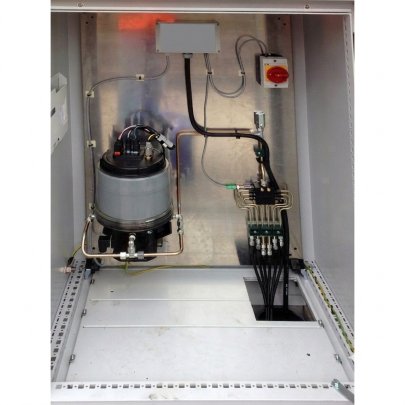
Centralized Automatic Grease Lubrication Systems eliminate the single largest cause of bearing failure worldwide: inconsistent manual greasing. Engineered to DIN 51825 grease classification compatibility and built for single-line, dual-line, and progressive architectures, our systems match the reliability standards used by leading crane, mining, and wind-turbine OEMs.
Engineering & Working Principle
A central pump (electric, pneumatic, or spring-driven) pressurizes grease (NLGI grade 000–2) to 30–350 bar depending on system type. Progressive or dual-line metering valves dispense precise, individually adjustable shot volumes (0.03–2 cc per cycle) to each point on a programmable timer, distance-based, or condition-triggered cycle. Blockage detection and low-level sensors feed back to a central controller for real-time diagnostics.
Technical Specifications
Standards Compliance
DIN 51825 (grease classification), ISO 6743-9, CE-marked components
Key Features
Applications
Mobile cranes, tower cranes, wind turbines, mining shovels and draglines, conveyor systems, marine deck equipment, and steel mill machinery.
Why It Outperforms Standard Systems
Where basic grease systems rely on fixed-interval dispensing, our progressive and IoT-enabled architectures adjust to actual operating conditions and provide verifiable proof of lubrication at every point — the same standard demanded by global crane and wind OEMs.
Benefits
Manual greasing is inconsistent by nature — human error causes both over- and under-lubrication, the top cause of premature bearing failure. Centralized systems deliver precisely metered shots (±5% accuracy) automatically, every cycle, without exception.
Single-line systems use a resistance-based approach suited to smaller point counts; dual-line systems handle larger point counts over long distances with alternating supply lines; progressive systems offer individually adjustable metering per point and are preferred for critical or high-value assets like cranes and wind turbines.
Yes — integrated pressure sensors and cycle-counters detect blockages or line failures in real time and trigger an alarm, preventing a starved bearing from running undetected until failure.
Systems are compatible with NLGI grade 000 to NLGI 2 greases per DIN 51825, covering the vast majority of industrial and mobile equipment lubricants, including lithium, calcium sulfonate, and synthetic-based greases.
Yes — IoT-enabled controllers report lubrication cycles, faults, and reservoir levels to a central dashboard, giving fleet-wide or plant-wide visibility exactly like the systems specified on premium crane and wind-turbine OEM platforms.